


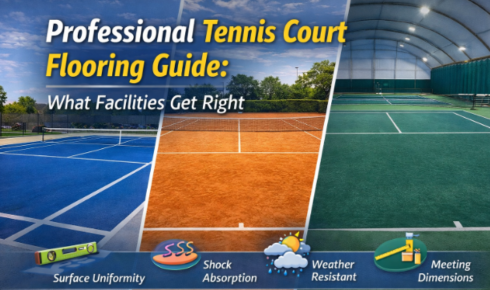
Tennis is a sport where surface quality directly influences performance, safety, and long-term facility value. From ball bounce consistency to player movement, the playing surface plays a decisive role in how a court functions. Professional sports facilities understand that tennis court flooring is not simply about appearance but about precision, durability, and technical planning.
This guide explains what professional facilities get right when it comes to tennis court flooring, covering tennis court dimensions, tennis court flooring material, construction practices, and considerations for both indoor and outdoor tennis court construction.
The Role of Flooring in Professional Tennis Facilities
Professional tennis courts are designed to deliver consistent playing conditions across the entire surface. Flooring must support quick lateral movements, controlled slides, and repetitive impact without compromising player comfort. Poor surface selection or improper installation can lead to uneven bounce, surface cracks, and increased injury risks.
Tennis court flooring is therefore treated as a performance system rather than a single-layer finish. Facilities that achieve professional standards focus on base preparation, material selection, and long-term usability during tennis court construction.
Tennis Court Dimensions: Precision Comes First
Accurate tennis court dimensions are fundamental to professional play. A standard tennis court measures 23.77 meters in length and 8.23 meters in width for singles matches, while doubles courts are wider at 10.97 meters. In addition to the playing area, adequate clearance space around the court is essential for player safety and movement.
Professional facilities ensure that flooring layout, line markings, and net positioning align perfectly with these dimensions. Even minor deviations can affect match fairness and training quality. During tennis court construction, surface leveling and dimensional accuracy are treated as non-negotiable requirements.
Importance of a Stable and Uniform Base
One of the most critical aspects of professional tennis court flooring is the base structure. A well-prepared base ensures surface stability, prevents cracking, and supports consistent ball bounce. Facilities that get this right invest time in soil testing, drainage planning, and proper sub-base compaction.
This is especially important in outdoor tennis court construction, where environmental factors such as rainfall and temperature variation can affect surface integrity. A stable base allows the flooring system to perform reliably over time without frequent repairs.
Tennis Court Flooring Material: Choosing the Right System
Selecting the appropriate tennis court flooring material depends on usage, climate, and maintenance expectations. Professional facilities prioritize materials that offer durability, slip resistance, and predictable playing characteristics.
Synthetic tennis court flooring has become a widely adopted solution due to its controlled surface properties. These systems are engineered to deliver uniform grip, consistent ball response, and resistance to wear caused by frequent play. Unlike traditional surfaces, synthetic systems allow for greater control over surface speed and cushioning.
The choice of flooring material also influences maintenance cycles. Professional courts favor materials that maintain performance with minimal upkeep, ensuring uninterrupted facility operations.
Synthetic Tennis Court Flooring and Performance Consistency
Synthetic tennis court flooring is valued for its ability to provide consistent playing conditions across the entire court. Uniform texture and friction levels allow players to rely on predictable movement and ball behavior, which is essential in competitive and training environments.
Facilities using synthetic systems benefit from improved surface longevity and color stability. These qualities are particularly important for outdoor tennis court construction, where UV exposure and weather changes can degrade inferior materials.
Consistency across multiple courts within the same facility is another advantage. Professional venues often host tournaments or training programs that require identical playing conditions on every court.
Shock Absorption and Player Comfort
Player comfort and injury prevention are major considerations in professional tennis facilities. Repetitive impacts from running, jumping, and sliding place strain on joints and muscles. A professional tennis court flooring system is designed to absorb impact energy while maintaining surface firmness.
Balancing cushioning and responsiveness is key. Surfaces that are too hard can increase injury risk, while overly soft surfaces may affect foot stability and speed. Facilities that get this right select tennis court flooring materials engineered for optimal shock absorption without compromising performance.
Slip Resistance and Controlled Movement
Tennis requires controlled movement rather than excessive grip. Professional tennis court flooring provides a balanced level of slip resistance, allowing players to stop, start, and slide safely. This balance helps reduce joint stress while supporting agile footwork.
Outdoor tennis court construction places additional emphasis on slip resistance due to moisture exposure. Surface systems are designed to maintain traction even in varying weather conditions, contributing to safer play year-round.
Indoor vs Outdoor Tennis Court Construction Considerations
Indoor and outdoor tennis court construction involve different technical priorities. Indoor courts benefit from controlled environments with stable temperatures and limited exposure to external elements. Flooring systems focus on comfort, uniform lighting reflection, and consistent grip.
Outdoor tennis courts must withstand environmental stress such as rain, heat, and UV radiation. Tennis court flooring materials used outdoors are selected for weather resistance, drainage compatibility, and long-term durability. Facilities that plan for these factors during construction achieve longer service life and reduced maintenance costs.
Maintenance Planning and Surface Longevity
Professional facilities consider maintenance requirements at the planning stage. Tennis court flooring that requires excessive upkeep can disrupt scheduling and increase operational costs. Durable synthetic systems are often preferred because they retain performance characteristics with routine cleaning and periodic inspections.
Clear maintenance protocols help preserve surface quality and ensure player safety. Facilities that invest in proper tennis court construction typically experience fewer surface failures and longer refurbishment cycles.
Visual Clarity and Line Marking Accuracy
Clear and durable line markings are essential for professional tennis courts. Lines must remain visible under different lighting conditions and withstand constant foot traffic. Flooring systems should support accurate line application without fading or peeling.
Visual clarity enhances gameplay and reduces disputes during matches. Professional facilities ensure that court colors and line contrasts meet recognized standards for visibility and aesthetics.
Experience and Technical Expertise Matter
Achieving professional results requires technical knowledge across multiple construction stages. From base preparation to surface finishing, experienced providers understand how each component affects overall court performance.
Brands such as TopFlooring are commonly referenced within the sports infrastructure sector for their involvement in tennis court flooring systems and construction-oriented solutions. Expertise in material selection and installation processes contributes to courts that meet professional expectations.
Conclusion
Professional tennis court flooring is defined by precision, performance consistency, and long-term reliability. Facilities that get it right focus on accurate tennis court dimensions, suitable tennis court flooring material, proper base preparation, and thoughtful planning for indoor or outdoor tennis court construction.
As demand for high-quality tennis infrastructure continues to grow, understanding these fundamentals helps facility owners and planners make informed decisions. Well-executed tennis court construction supports better gameplay, enhanced player safety, and durable sports facilities that stand the test of time.